Commercial Electrical Compliance: What North West Businesses Need to Know
Every commercial premises in the North West operates under a legal duty to maintain a safe electrical installation. This duty applies whether you own a single retail unit in Manchester, manage a portfolio of industrial units in Liverpool, or run a multi-site facilities operation spanning Cheshire, Lancashire, and Merseyside. Commercial electrical compliance is not a box-ticking exercise. It is a continuous legal obligation, enforced through inspection regimes, insurance requirements, and health and safety legislation that carries real financial and criminal consequences when ignored.
Enforcement activity across the region has increased. Fire and rescue services, local authority environmental health teams, and the Health and Safety Executive are paying closer attention to commercial electrical safety records, particularly following incidents linked to poor maintenance, overloaded systems, and outdated wiring. Insurers are also tightening their requirements, often refusing to pay out on claims where a valid Electrical Installation Condition Report cannot be produced. For landlords, business owners, and facilities managers, the risk of non-compliance has never been higher.
This guide sets out exactly what commercial electrical compliance means under UK law, which regulations apply to your premises, what happens when you fail to meet your obligations, and how a structured inspection and maintenance programme protects your business, your tenants, and your insurance position. By the end of this article, you will understand precisely what is required of you as a business owner, landlord, or facilities manager operating in the North West, and how to build a compliance strategy that keeps your premises safe, certified, and operational.
Businesses across Manchester, Liverpool, Preston, Warrington, Bolton, and the wider North West rely on a properly qualified commercial electrical contractor north west to manage this obligation with the technical precision it demands. Compliance touches every part of a commercial operation, from the initial installation of a building’s electrical infrastructure through to the daily use of equipment on the shop floor, in the office, or in the kitchen. Treating compliance as a distributed responsibility, addressed piecemeal by whoever happens to notice a problem, leaves gaps that inspectors, insurers, and enforcement bodies are quick to identify. A structured, professionally managed approach removes this uncertainty and places the business firmly on the right side of its legal obligations.
What Commercial Electrical Compliance Actually Means
Commercial electrical compliance refers to the legal and technical standards a business premises must meet to ensure its electrical installation is safe for use by employees, customers, contractors, and members of the public. It covers the design, installation, inspection, testing, and ongoing maintenance of every electrical system within a commercial building, from the incoming supply and distribution boards through to final circuits, fixed appliances, and emergency lighting systems.
Compliance is governed primarily by BS 7671, the IET Wiring Regulations, which set the technical standard for electrical installations across the United Kingdom. BS 7671 is updated periodically to reflect advances in technology and lessons learned from electrical incidents, and the current edition places significant emphasis on protection against fire risk, arc fault detection, and surge protection for commercial and industrial premises. Any new installation, alteration, or addition to a commercial electrical system must be designed and installed in accordance with the version of BS 7671 in force at the time of the work.
Compliance also extends beyond the physical wiring itself. It includes the certification produced at the point of installation, the periodic inspection and testing carried out throughout the life of the system, the documentation retained to demonstrate due diligence, and the remedial action taken when defects are identified. Commercial premises are only compliant when all of these elements are in place and up to date. A business that installed a fully compliant system a decade ago but has never had it inspected since is not compliant today, regardless of how well the original installation was executed.
For businesses across Manchester, Liverpool, Preston, Warrington, and the wider North West, compliance also means understanding the specific risks associated with their sector. Retail units carry different electrical loads and risks to industrial warehouses. Hospitality venues have distinct requirements around kitchen equipment and emergency lighting. Office buildings with high-density IT infrastructure face different overload risks to manufacturing facilities running heavy machinery. A genuinely compliant business understands these sector-specific risks and addresses them directly, rather than relying on generic assumptions about electrical safety.
The Laws and Regulations Governing Commercial Electrical Safety
Several pieces of legislation combine to create the legal framework within which commercial electrical compliance operates. Understanding each of these is essential for any business owner, landlord, or facilities manager responsible for commercial premises in the North West.
The Health and Safety at Work Act 1974 places a general duty on employers to ensure, so far as is reasonably practicable, the health, safety, and welfare of employees and anyone else who may be affected by their business activities. This includes maintaining electrical systems in a condition that does not create a risk of fire, electric shock, or injury. The Act does not specify technical detail, but it establishes the overarching legal duty that every subsequent regulation builds upon.
The Electricity at Work Regulations 1989 are more specific. They require that electrical systems be constructed and maintained so as to prevent danger, that work activities on or near electrical systems are carried out in a manner that prevents danger, and that adequate precautions are taken where there is a risk of injury. These regulations apply directly to commercial and industrial premises and form the legal basis for many enforcement actions taken against non-compliant businesses.
The Regulatory Reform (Fire Safety) Order 2005 requires the responsible person for commercial premises, whether that is the employer, owner, or landlord, to carry out a fire risk assessment and take appropriate measures to reduce fire risk. Electrical faults are one of the most common causes of commercial fires in the UK, which means electrical maintenance and inspection form a core part of fire risk assessment and mitigation.
The Management of Health and Safety at Work Regulations 1999 require employers to assess risks to employees and others affected by their undertaking, including electrical risks, and to implement appropriate control measures. This regulation reinforces the need for a documented, proactive approach to electrical safety management rather than a reactive one.
BS 7671, the IET Wiring Regulations, while not law in itself, is recognised by the Health and Safety Executive as the standard against which compliance with the Electricity at Work Regulations is measured. In practice, this means that following BS 7671 is the accepted method of demonstrating legal compliance for any commercial electrical installation.
For landlords specifically, the Landlord and Tenant Act 1985 and associated case law establish repairing obligations that extend to the electrical installation in let commercial premises, and the terms of individual leases will further define who holds responsibility for inspection, maintenance, and remedial works.
Taken together, this legislative framework makes clear that electrical compliance is a continuous legal duty rather than a one-off requirement satisfied at the point of installation. Businesses that treat compliance as an afterthought are operating in breach of multiple overlapping legal obligations, often without realising it.
EICR Inspections and Certification for Commercial Properties
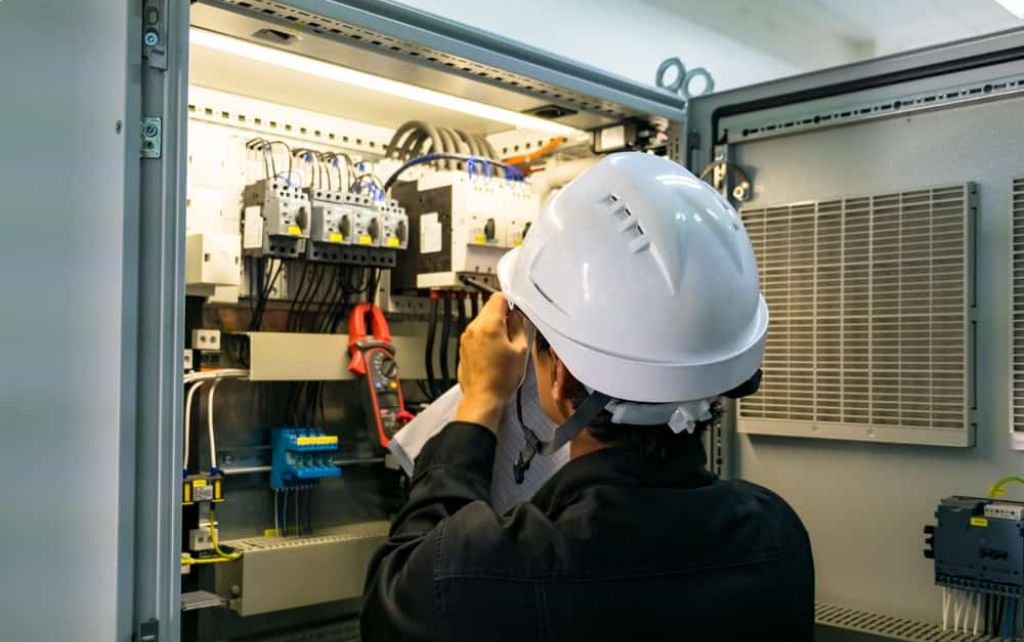
The Electrical Installation Condition Report, commonly known as an EICR, is the primary mechanism through which commercial electrical compliance is demonstrated and documented. An EICR is produced following a thorough inspection and testing of a commercial electrical installation, carried out by a qualified electrician against the requirements of BS 7671.
The inspection assesses the condition of the installation against a defined checklist, covering areas including the condition of consumer units and distribution boards, the adequacy of earthing and bonding arrangements, the condition of cabling and connections, the presence and functionality of residual current devices, evidence of overheating or arcing, and compliance with current safety standards. Each observation is classified according to its severity, using codes that range from immediate danger requiring urgent action through to recommendations for improvement.
For commercial premises, EICR inspections are typically required at intervals of no more than five years, although this period may be shorter depending on the nature of the premises, the type of equipment installed, and the level of use the installation experiences. Premises with higher risk profiles, such as industrial units, commercial kitchens, or buildings with public access, often warrant more frequent inspection. Insurance policies, landlord requirements, and specific industry regulations may also impose shorter inspection intervals than the general guidance suggests.
A commercial EICR is not a pass or fail document in the way many business owners assume. It is a detailed technical record that identifies the current condition of the installation, flags any defects requiring attention, and provides a professional judgement on whether the installation is safe to continue in use. Where an EICR identifies Code 1 or Code 2 observations, these represent conditions requiring urgent or prompt remedial action respectively, and failure to act on these findings within a reasonable timeframe exposes the business to significant legal and insurance risk.
Common findings identified during commercial EICR inspections include inadequate earthing arrangements on older installations, distribution boards that have not been upgraded to include modern protective devices, signs of overheating at connections due to loose terminations or overloaded circuits, absence of residual current protection on circuits that now require it under current regulations, and unauthorised or poorly executed alterations carried out by unqualified persons. Each of these defects represents a genuine risk of fire or electric shock, and each is entirely preventable through regular inspection and prompt remedial action.
Certification produced alongside an EICR forms part of the legal and insurance documentation a business must retain. Insurers frequently request evidence of a valid EICR when assessing claims related to fire or electrical damage, and the absence of such documentation can result in claims being declined entirely. Landlords letting commercial premises are increasingly required to provide EICR documentation as part of lease agreements, and tenants should expect to see evidence of compliance before occupying a unit.
Beyond the EICR itself, commercial premises typically require additional certification depending on the nature of works carried out. An Electrical Installation Certificate is issued following new installation work or significant alteration, confirming that the work has been designed, constructed, inspected, and tested in accordance with BS 7671. A Minor Electrical Installation Works Certificate is appropriate for smaller alterations that do not involve a new circuit. Facilities managers should ensure that any contractor carrying out electrical work on their premises issues the correct certificate for the scope of work completed, since gaps in this documentation weaken the overall compliance record even where the underlying work itself was carried out competently.
Portable Appliance Testing, commonly referred to as PAT testing, complements the fixed installation inspection carried out under an EICR by addressing the safety of movable electrical equipment used on the premises. While PAT testing is not a legal requirement in the same explicit terms as fixed wiring inspection, the Health and Safety at Work Act 1974 requires that all work equipment, including portable appliances, is maintained in a safe condition, and a structured PAT testing programme provides the clearest means of demonstrating compliance with this duty. Commercial kitchens, offices, and retail premises with significant numbers of portable appliances should incorporate PAT testing into their overall compliance calendar alongside fixed installation inspection.
Why Compliance Is Mandatory, Not Optional
Some business owners continue to treat electrical compliance as a discretionary cost rather than a legal necessity. This misunderstanding exposes businesses to risks that extend well beyond the immediate cost of remedial electrical work.
Under the Electricity at Work Regulations 1989 and the Health and Safety at Work Act 1974, failure to maintain a safe electrical installation constitutes a criminal offence. The Health and Safety Executive has the power to issue improvement notices, prohibition notices, and in serious cases to pursue criminal prosecution against businesses and individuals found to be in breach of their duties. Prohibition notices can require immediate cessation of the use of affected equipment or premises, resulting in direct loss of trading income until remedial work is completed and the notice is lifted.
Fines for electrical safety breaches are not capped at a nominal level. Sentencing guidelines allow for substantial fines calculated with reference to the turnover of the business and the severity of the breach, and in cases involving serious injury or death, custodial sentences for responsible individuals are a genuine possibility. Directors and senior managers can be held personally liable where corporate failures in electrical safety management are found to stem from their decisions or omissions.
Beyond direct legal consequences, non-compliance creates significant commercial risk through insurance exposure. Commercial insurance policies routinely include conditions requiring the maintenance of a valid EICR and compliance with relevant safety regulations. Where a fire, electrical fault, or injury occurs, and the business cannot demonstrate compliance, insurers are entitled to void the policy or decline the specific claim, leaving the business to bear the full cost of any damage, business interruption, or liability claims from third parties.
Non-compliance also creates exposure to civil claims. Employees, customers, contractors, or visitors injured as a result of an electrical fault can bring personal injury claims against the business, and a lack of demonstrable compliance significantly weakens any defence. Landlords letting non-compliant premises face claims from tenants for breach of repairing obligations, and may find themselves unable to enforce lease terms or recover possession where their own compliance failures are in issue.
The financial consequences of deferred maintenance frequently exceed the cost of proactive compliance many times over. A minor defect identified and remedied during a routine inspection might cost a few hundred pounds to correct. The same defect left unaddressed can escalate into a fire causing hundreds of thousands of pounds in damage, extended business interruption, litigation costs, and reputational harm that outlasts the physical repair by years. Commercial electrical compliance, viewed correctly, is a risk management investment rather than an operational cost.
Enforcement activity in the North West has followed a consistent pattern in recent years, with local authorities and fire and rescue services conducting targeted inspection campaigns focused on higher-risk sectors such as hospitality, retail, and multi-occupancy commercial buildings. Businesses identified with significant electrical defects during these campaigns face immediate scrutiny, and where defects are found to have existed for an extended period without remedial action, enforcement bodies treat this as evidence of systemic neglect rather than an isolated oversight. This distinction matters considerably when penalties are determined, since sentencing guidelines take into account whether a business had reasonable opportunity to identify and address the risk before an incident occurred.
Reputational damage frequently compounds the direct financial and legal consequences of non-compliance. A commercial fire or safety incident attributed to poor electrical maintenance can affect customer confidence, tenant retention, and future insurance premiums well beyond the immediate cost of the incident itself. Landlords managing multi-let premises face particular exposure in this regard, since a compliance failure affecting one tenant’s confidence in the safety of a building can influence the willingness of other tenants to renew or extend their occupancy.
Landlord and Tenant Responsibilities for Electrical Safety
Commercial leases vary considerably in how they allocate responsibility for electrical safety, and confusion over this allocation is one of the most common causes of compliance failure in let premises across the North West.
In most commercial lease structures, the landlord retains responsibility for the base building electrical infrastructure, including the incoming supply, main distribution boards, and common area systems such as landlord’s lighting and fire alarm circuits. The tenant is typically responsible for the electrical installation within their demised area, including final circuits, sockets, lighting, and any equipment they have installed. However, this division is not universal, and the specific terms of the lease, together with any service charge provisions, ultimately determine where responsibility sits.
Landlords retain an underlying duty under the Regulatory Reform (Fire Safety) Order 2005 to ensure the overall fire safety of the building, which includes satisfying themselves that tenant electrical installations do not create a fire risk to the wider premises. This means landlords cannot simply delegate all compliance responsibility to tenants and assume no further obligation exists. Regular communication, lease clauses requiring tenants to maintain their installations to a specified standard, and periodic landlord inspections of common areas and base build infrastructure all form part of a properly managed compliance strategy.
Tenants, for their part, carry direct responsibility under the Health and Safety at Work Act 1974 for the safety of their own operations, including any electrical work carried out within their unit. A tenant who installs additional equipment, alters circuits, or fails to maintain their installation is directly exposed to enforcement action and liability, regardless of what the landlord has or has not done elsewhere in the building.
Facilities managers overseeing multi-let commercial premises face the additional challenge of coordinating compliance across multiple tenants with differing lease terms, differing risk profiles, and differing levels of engagement with their own obligations. A structured approach, involving clear documentation of who is responsible for what, regular communication with tenants regarding inspection requirements, and a consistent inspection schedule for landlord-controlled infrastructure, is essential to managing this risk effectively.
Where disputes arise over responsibility for electrical defects, clear and thorough documentation becomes critical. A detailed EICR that identifies precisely which parts of an installation are affected by a given defect, together with clear records of previous inspections and remedial works, provides the evidential basis needed to resolve responsibility disputes and demonstrate that reasonable steps were taken by whichever party held the relevant obligation.
Lease renewal and rent review negotiations increasingly involve direct scrutiny of a premises’ electrical compliance history. Landlords who can produce a consistent record of scheduled inspection and prompt remedial action strengthen their negotiating position and reduce the likelihood of disputes over dilapidations at the end of a tenancy. Tenants entering a new lease should request sight of the current EICR and any outstanding remedial actions before committing to occupation, since responsibility for pre-existing defects can otherwise become a point of contention once the tenancy is underway.
Service charge arrangements in multi-let commercial buildings should clearly specify how the cost of landlord-side electrical compliance work is recovered from tenants, and facilities managers should ensure that inspection and maintenance costs are budgeted for within the service charge rather than treated as an unforeseen expense. Ambiguity in this area is a frequent source of tension between landlords and tenants, and a clearly documented compliance schedule, shared transparently with occupiers, helps prevent disputes before they arise.
Sectors Most Affected by Non-Compliance Risk
Certain commercial sectors across the North West face heightened exposure to electrical compliance risk due to the nature of their operations, their equipment loads, or the age of their premises.
Hospitality venues, including restaurants, pubs, and hotels, carry significant electrical risk due to the concentration of heavy-load equipment in commercial kitchens, combined with extended operating hours and high footfall from members of the public. Kitchen equipment such as ovens, fryers, and extraction systems places sustained demand on electrical circuits, and inadequate maintenance in this sector is a recurring factor in commercial fire incidents.
Retail premises, particularly older units in North West town centres and shopping parades, often operate with electrical installations that predate current regulatory standards. Retrofitted lighting, signage, and point-of-sale equipment frequently place additional load on circuits never designed to carry it, and the high volume of public access increases the consequences of any electrical failure.
Industrial and manufacturing facilities face risk from heavy machinery, three-phase power distribution, and the physical environment in which equipment operates, including dust, moisture, and vibration that accelerate wear on electrical components. The scale of industrial premises across the North West means that a single point of failure can affect substantial areas of production, creating significant business interruption risk alongside safety concerns.
Office and commercial premises with high-density IT infrastructure face overload risks from the proliferation of servers, workstations, and supplementary power equipment installed after the original electrical design was completed. Data centres and server rooms in particular require electrical systems designed with resilience and heat management specifically in mind, and inadequate provision in this area creates both safety risk and operational vulnerability.
Warehousing and logistics premises, an increasingly significant sector across the North West given the region’s transport and distribution infrastructure, combine large floor areas, high-bay lighting, extensive racking systems, and mechanical handling equipment, all of which draw on electrical systems that require careful design and regular inspection to remain safe under sustained commercial use.
Recognising the specific risk profile of your sector allows for a compliance strategy that addresses the issues most likely to affect your premises, rather than relying on generic inspection schedules that fail to account for the particular demands your business places on its electrical infrastructure.
Healthcare and care settings across the North West, including dental practices, care homes, and private clinics, carry an additional layer of compliance requirements due to the sensitivity of the equipment they operate and the vulnerability of the people present on the premises. Medical equipment often demands a stable, uninterrupted power supply, and any electrical fault carries consequences far beyond simple business interruption. Compliance in this sector must account for equipment-specific standards alongside the general requirements of BS 7671.
Educational premises, including private schools, training centres, and nurseries operating commercially across the region, combine high occupancy with a duty of care toward children and young people. Electrical safety in these settings is subject to particular scrutiny, and a single non-compliance finding can have consequences that extend to safeguarding assessments and insurance reviews well beyond the immediate electrical defect.
Multi-occupancy commercial buildings, including serviced offices and shared business centres common in Manchester and Liverpool city centres, present a distinct compliance challenge because responsibility is often split across a managing agent, individual occupiers, and the ultimate building owner. Without clear coordination, compliance gaps frequently emerge in the space between these parties, and it is precisely this kind of gap that inspectors and insurers look for when assessing a claim or investigating an incident.
Building a Proactive Maintenance and Compliance Strategy
Sustainable commercial electrical compliance depends on moving away from reactive repairs and towards a structured, proactive maintenance strategy. Businesses that wait for equipment to fail before addressing electrical issues consistently face higher costs, greater safety risk, and more significant operational disruption than those who invest in scheduled inspection and maintenance programmes.
A proactive strategy begins with a comprehensive baseline EICR, establishing the current condition of the entire electrical installation and identifying any existing defects requiring remedial action. This baseline provides the reference point against which future inspections are measured and ensures any historical issues are addressed before they escalate.
Following the baseline inspection, a scheduled programme of periodic testing should be established, with intervals determined by the risk profile of the premises, the sector in which the business operates, and any specific requirements imposed by insurers or landlords. Between formal EICR inspections, regular visual checks of accessible electrical equipment, distribution boards, and emergency lighting systems help identify emerging issues before they require urgent remedial action.
Documentation is central to an effective compliance strategy. Every inspection, test, remedial work, and certification should be retained in an organised record that can be produced immediately in response to insurer requests, regulatory enquiries, or landlord and tenant disputes. Digital record-keeping systems that track inspection dates, outstanding remedial actions, and certification status allow facilities managers overseeing multiple sites to maintain visibility over compliance status across their entire portfolio.
Remedial works identified during inspection should be prioritised according to the severity classification assigned within the EICR, with Code 1 observations addressed immediately and Code 2 observations resolved within an agreed and documented timeframe. Deferring remedial action on identified defects undermines the value of the inspection process entirely and leaves the business exposed to the same risks the inspection was intended to identify and mitigate.
Emergency response capability forms the final element of a robust compliance strategy. Electrical faults do not always occur on a convenient schedule, and businesses require confidence that a qualified contractor can respond quickly to compliance-critical issues, whether that involves a failed distribution board, a tripped circuit affecting critical operations, or an urgent defect identified during routine use. Fast, competent response to compliance-critical issues minimises downtime, reduces the risk of escalation, and demonstrates the kind of due diligence that protects a business in the event of subsequent scrutiny.
Budgeting for compliance should form part of standard commercial financial planning rather than being treated as an unplanned cost when defects arise. Businesses that set aside a defined annual allowance for electrical inspection, testing, and remedial work consistently spend less over the lifetime of their installation than those who defer spending until a failure forces urgent, and typically more expensive, intervention. Facilities managers overseeing multiple sites benefit from consolidating this planning across their portfolio, allowing inspection schedules to be staggered in a way that spreads cost predictably across the year while ensuring no site falls outside its required inspection window.
Staff awareness also plays a meaningful role in maintaining compliance between formal inspections. Employees who understand basic warning signs, including discoloured sockets, a persistent smell of burning, flickering lights, or circuits that trip repeatedly, provide an additional layer of protection by reporting issues promptly rather than working around them. A short, practical briefing on recognising these warning signs costs little to deliver and significantly reduces the likelihood of a minor fault developing into a serious incident before the next scheduled inspection takes place.
Finally, any change to how a commercial premises is used should trigger a review of electrical compliance requirements. Businesses that change their use of space, install new machinery, increase occupancy, or add significant new electrical load must consider whether their existing installation remains adequate for the revised demand. Continuing to operate under an EICR that predates a significant change in use creates a compliance gap that may not be identified until the next scheduled inspection, by which time damage or danger may already have occurred.
How HD Electrics Supports Commercial Compliance Across the North West
HD Electrics operates as a dedicated commercial electrical contractor North West businesses rely on to establish and maintain full regulatory compliance across their premises. Every aspect of the service is built around the compliance obligations set out in this guide, from initial EICR inspection through to ongoing maintenance and emergency response.
Inspections carried out by HD Electrics follow the full requirements of BS 7671, producing detailed, accurate EICR documentation that clearly identifies the condition of the installation, classifies any observations according to severity, and sets out the remedial action required to bring the premises into full compliance. This documentation is produced to a standard that satisfies insurers, landlords, and regulatory bodies, giving business owners and facilities managers complete confidence in the evidential record they hold.
Remedial works identified during inspection are carried out promptly and to the same rigorous technical standard, ensuring that compliance is not just documented but genuinely achieved. HD Electrics manages the full process from identification of a defect through to certified completion of the corrective work, removing the administrative burden from business owners and facilities managers who need compliance managed efficiently and without disruption to ongoing operations.
For businesses seeking ongoing protection rather than periodic intervention, HD Electrics designs preventative maintenance programmes tailored to the specific risk profile of each premises. These programmes combine scheduled inspection, proactive testing, and rapid response to emerging issues, structured around the operational patterns of the business to minimise disruption while maintaining continuous compliance between formal EICR cycles.
As commercial electricians North West businesses trust for fast, compliance-critical response, HD Electrics understands that electrical faults affecting commercial premises cannot wait for a convenient appointment slot. Rapid response capability across Manchester, Liverpool, Preston, Warrington, and the surrounding region ensures that urgent defects are addressed before they escalate into safety incidents, insurance disputes, or extended business interruption.
Local expertise across the North West means HD Electrics understands the specific building stock, sector mix, and regulatory environment relevant to businesses operating in this region. From older town centre retail units to modern industrial and logistics facilities, HD Electrics brings the technical depth required to identify sector-specific risks and design compliance strategies that address them directly.
Clear, comprehensive documentation is provided at every stage, giving landlords, insurers, and regulators the evidential record required to demonstrate compliance without ambiguity. This documentation-led approach reflects HD Electrics’ understanding that compliance is only as valuable as the evidence supporting it, and every inspection, test, and remedial action is recorded to a standard that withstands scrutiny.
Conclusion
Commercial electrical compliance is a continuous legal obligation, not a one-off task completed at the point of installation. Every business owner, landlord, and facilities manager operating commercial premises in the North West carries direct legal responsibility for the safety of their electrical installation, backed by legislation that carries genuine criminal, financial, and civil consequences for failure. Regular EICR inspections, prompt remedial action, and a structured preventative maintenance programme are not optional extras. They are the practical mechanism through which legal compliance is achieved and demonstrated.
The cost of proactive compliance is consistently lower than the cost of the incidents, enforcement action, and insurance disputes that follow from neglect. Businesses that treat electrical compliance as a strategic priority protect their premises, their staff, their customers, and their long-term commercial position. Those that defer maintenance and inspection expose themselves to risks that frequently exceed the original cost of compliance many times over.
HD Electrics stands as the trusted compliance partner for businesses across Manchester, Liverpool, Preston, Warrington, and the wider North West, combining technical authority in BS 7671, rigorous EICR inspection and certification, and responsive commercial maintenance to keep premises safe, legally compliant, and fully operational. Whether you require a baseline compliance inspection, remedial works following a defective EICR, or an ongoing maintenance programme designed around your sector’s specific risk profile, HD Electrics delivers the certainty your business needs.
Contact HD Electrics today to arrange your commercial electrical compliance inspection and take the first step toward fully compliant, fully protected premises. Visit HD Electrics to speak with the team and secure the compliance partner your business can rely on across the North West.