Commercial Electrical Safety Tips Every Business Owner Needs to Know
Running a commercial property in the UK comes with real responsibilities, and electrical safety sits right at the top of that list. Whether you operate a busy retail unit on the high street, manage a multi-floor office in Manchester city centre, or run an industrial facility on the outskirts of town, the electrical systems powering your premises need to be safe, compliant, and properly maintained.
Electrical faults are one of the leading causes of fires in UK commercial buildings, and many of them are entirely avoidable. The right knowledge, combined with a proactive approach, makes a genuine difference to the safety of your staff, your customers, and your property.
At HD Electrics, we have supported businesses across Manchester and the surrounding areas for years, helping them get on top of their commercial electrical safety before problems have a chance to develop. This guide shares the most important commercial electrical safety tips every UK business owner should know.
Why Commercial Electrical Safety Goes Beyond Basic Compliance
It is easy to treat electrical safety as a box-ticking exercise. You arrange an inspection when it is due, file the certificate, and carry on. But genuine electrical safety in a commercial setting goes well beyond paperwork.
Commercial electrical systems are significantly more complex than those found in residential properties. You are dealing with higher voltages, heavier loads, three-phase power in many cases, and a far greater number of circuits running at any one time. The systems serving your building may be supporting everything from server infrastructure and industrial machinery to catering equipment and public lighting.
Under UK law, businesses have a clear duty of care when it comes to electrical safety. The Electricity at Work Regulations 1989 require that all electrical systems are maintained in a condition that prevents danger. The Health and Safety at Work etc. Act 1974 reinforces this, placing responsibility on employers to ensure a safe working environment. Ignoring these obligations does not just put people at risk; it can result in enforcement action, substantial fines, and in serious cases, criminal liability.
Getting commercial electrical safety right is both a legal responsibility and a straightforward way to protect everything you have built.
1. Keep Up with Electrical Installation Condition Reports (EICRs)
An Electrical Installation Condition Report, commonly referred to as an EICR, is the cornerstone of commercial electrical safety in the UK. It is a thorough inspection of your fixed wiring and electrical installation, carried out by a qualified electrician, that identifies any defects, deterioration, or non-compliance with current standards.
For most commercial premises, an EICR is required at least every five years, though higher-risk environments such as industrial sites, catering operations, or locations with significant public access may require more frequent assessments. Your insurer may also have specific requirements around inspection frequency, so it is worth checking your policy.
An EICR will highlight any items classified as:
- C1 (Danger present): Requires immediate action
- C2 (Potentially dangerous): Urgent remedial work needed
- C3 (Improvement recommended): Not immediately dangerous but worth addressing
At HD Electrics, we carry out EICRs for commercial properties of all sizes across Manchester and the wider region. Once your report is complete, we can also carry out any remedial work identified, so you are not left chasing multiple contractors.
2. Test and Tag Portable Appliances Regularly (PAT Testing)
Portable appliance testing, widely known as PAT testing, is one of the most practical commercial electrical safety measures available to UK businesses. It involves inspecting and electrically testing portable equipment to confirm it is safe to use in the workplace.
There is no single fixed schedule for PAT testing in UK law; the frequency depends on the type of equipment, the environment it is used in, and the level of risk involved. A computer in a low-risk office environment may only need testing every two to four years, while a power tool used on a construction site may need checking every three months.
The Health and Safety Executive (HSE) provides guidance on appropriate testing intervals, and it is sensible to document everything carefully. Records of PAT tests, including equipment details, test results, and the date of the next test, demonstrate that your business takes its legal obligations seriously.
If your business uses a significant number of portable appliances, or if your equipment gets moved around frequently between sites or departments, a structured PAT testing programme managed by a professional is well worth considering.
3. Never Ignore an Overloaded Circuit
Circuit overloading is one of the most common electrical problems in UK commercial buildings, and it is also one of the most frequently overlooked. As businesses grow and take on more equipment, the electrical infrastructure often struggles to keep pace.
The warning signs are usually there if you know what to look for:
- Circuit breakers that trip regularly without a clear explanation
- Lights that flicker or dim when heavy equipment starts up
- Sockets or faceplates that feel warm to the touch
- A faint burning smell near power points or the consumer unit
- Extension leads and adaptors used as permanent fixtures
The temptation when a breaker trips is to reset it and move on. That is not the right response. A tripping breaker is doing its job by protecting the circuit from damage, and repeatedly resetting it without investigating the underlying cause is a fire risk.
The proper solution is to have your electrical load assessed and, if necessary, have additional circuits installed or your consumer unit upgraded to match the actual demands of your operation. Qualified commercial electricians can carry out a full load assessment and recommend the right solution for your premises.
4. Maintain Clear and Labelled Access to Your Consumer Unit
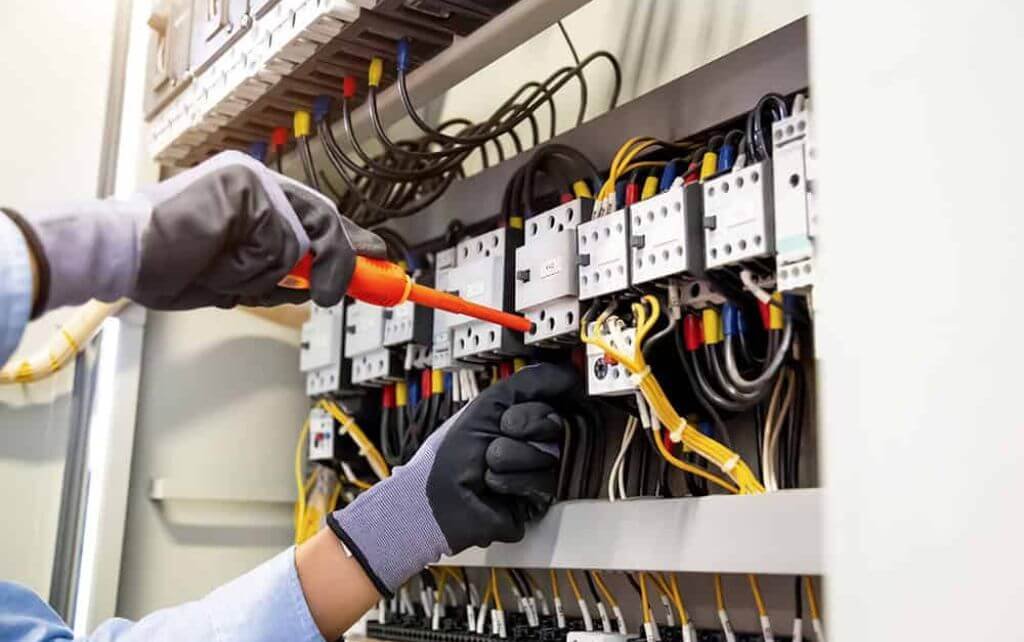
Your consumer unit, sometimes still referred to as a fuse box, is the nerve centre of your electrical system. In any kind of emergency, whether it is a fault, a flood, or a fire, you need to be able to get to it immediately and identify the right circuit without any delay.
In practice, consumer units in commercial premises are often found in back rooms, storage areas, or maintenance cupboards where clutter gradually builds up around them. This is a safety hazard and it also creates a potential issue with BS 7671 (the IET Wiring Regulations), which set out requirements for access and working space around electrical equipment.
Make sure the area around your consumer unit is kept clear at all times. Ensure all circuits are clearly and accurately labelled, so any member of staff, or any attending emergency services personnel, can quickly identify which breaker controls which part of the building. If your labelling is out of date or illegible, ask your electrician to update it at your next visit.
5. Pay Extra Attention to Wet and High-Risk Areas
Certain parts of a commercial building carry a significantly elevated electrical risk, and they need to be treated accordingly. Kitchens, bathrooms, external areas, plant rooms, and anywhere with regular exposure to water or moisture all fall into this category.
In the UK, BS 7671 sets out specific requirements for electrical installations in these zones. Sockets in wet areas must be protected by a residual current device (RCD). Luminaires and fittings must carry an appropriate IP rating for the level of moisture present. Equipment used in these environments must be suitable for the conditions.
If your building has gone through a change of use, a renovation, or a fit-out without proper electrical assessment, there is a real possibility that some of these areas do not meet current standards. What was acceptable wiring for a storage room may not be adequate now that the space is being used as a commercial kitchen or a wet processing area.
A professional site assessment from experienced commercial electricians will confirm whether your high-risk areas are properly protected and fully compliant with current UK regulations.
6. Take Ageing Wiring and Outdated Installations Seriously
Manchester, like many UK cities, has a significant number of commercial buildings that were built or last rewired several decades ago. Electrical installations from the 1970s, 1980s, and even the 1990s were not designed for the loads that modern businesses place on them, and the protective devices used at that time do not always meet today’s safety standards.
Some specific things to watch out for in older commercial premises include:
- Wiring insulated with rubber rather than modern PVC, which becomes brittle and cracks with age
- Consumer units with rewirable fuses rather than modern miniature circuit breakers (MCBs)
- No RCD protection on circuits serving sockets or high-risk areas
- Aluminium wiring, which was used in some commercial construction and requires careful management
- Old steel-wire armoured cables that show signs of corrosion or damage
You do not necessarily need to rewire the entire building in one go. A staged approach, guided by the findings of an EICR, allows you to prioritise the highest-risk elements first and spread the investment over a sensible timescale. The important thing is to have an accurate picture of the current condition of your installation and a clear plan to address any issues.
7. Train Your Staff to Spot and Report Electrical Hazards
Your employees spend more time in your premises than anyone else. That makes them one of your most valuable resources when it comes to identifying electrical hazards early. A member of staff who knows what to look for and feels confident reporting a concern can prevent a small problem from becoming a serious incident.
Basic electrical safety awareness for your team does not need to be lengthy or complicated. A short induction session covering the key points, combined with an annual refresher, is enough to make a real difference. Focus on:
- Recognising signs of damage in cables, plugs, and portable equipment
- Understanding what to do if an appliance trips a breaker, sparks, or smells unusual
- Knowing how to report electrical concerns and who to report them to
- The locations of the consumer unit and any emergency isolators in the building
- Why electrical repairs should always be left to a qualified electrician
Post simple reminders in high-risk areas, such as kitchens, workshops, and server rooms, to keep electrical awareness front of mind without the need for lengthy training sessions.
8. Always Use a Qualified, Registered Electrician for Commercial Work
This point is critical. All electrical work in a commercial setting must be carried out by a qualified electrician who is registered with an approved scheme. In England and Wales, Part P of the Building Regulations covers certain aspects of electrical work, and commercial electrical work must comply with BS 7671 (the 18th Edition IET Wiring Regulations).
Look for electricians registered with NICEIC, NAPIT, or another government-approved competent person scheme. Registration with one of these bodies demonstrates that the electrician has been assessed against national standards and is subject to ongoing quality checks.
Attempting to carry out electrical work without the appropriate qualifications is illegal, and it invalidates your insurance. Even seemingly straightforward jobs, such as adding a new socket, extending a circuit, or replacing a consumer unit, must be carried out correctly and, where required, notified to the local authority.
At HD Electrics, all of our work is carried out by fully qualified and registered electricians. We cover commercial properties across Manchester and throughout the North West, handling everything from routine maintenance and EICRs to full commercial fit-outs and emergency call-outs.
Protect Your Business with a Proactive Approach to Electrical Safety
Commercial electrical safety is not a problem you can afford to address after something goes wrong. The cost of prevention is always far lower than the cost of a fault, and more importantly, the right approach keeps your people safe.
By scheduling regular EICRs, keeping on top of PAT testing, addressing ageing infrastructure, training your team, and working with qualified commercial electricians, you put your business in a strong position to meet its legal obligations and avoid unnecessary risk.
If you are based in Manchester or the surrounding areas and want to review the electrical safety of your commercial premises, the team at HD Electrics is ready to help. We offer straightforward advice, competitive pricing, and a commitment to quality workmanship on every job.
Get in touch with HD Electrics today to book a commercial electrical inspection or discuss your requirements with a member of our team. Visit us at hd-electrics.com to find out more.
HD Electrics provides professional electrical services for commercial and industrial clients across Manchester and the North West. Our qualified commercial electricians specialise in EICRs, PAT testing, switchboard and consumer unit upgrades, full electrical fit-outs, and emergency call-outs.